
Vibration Test System
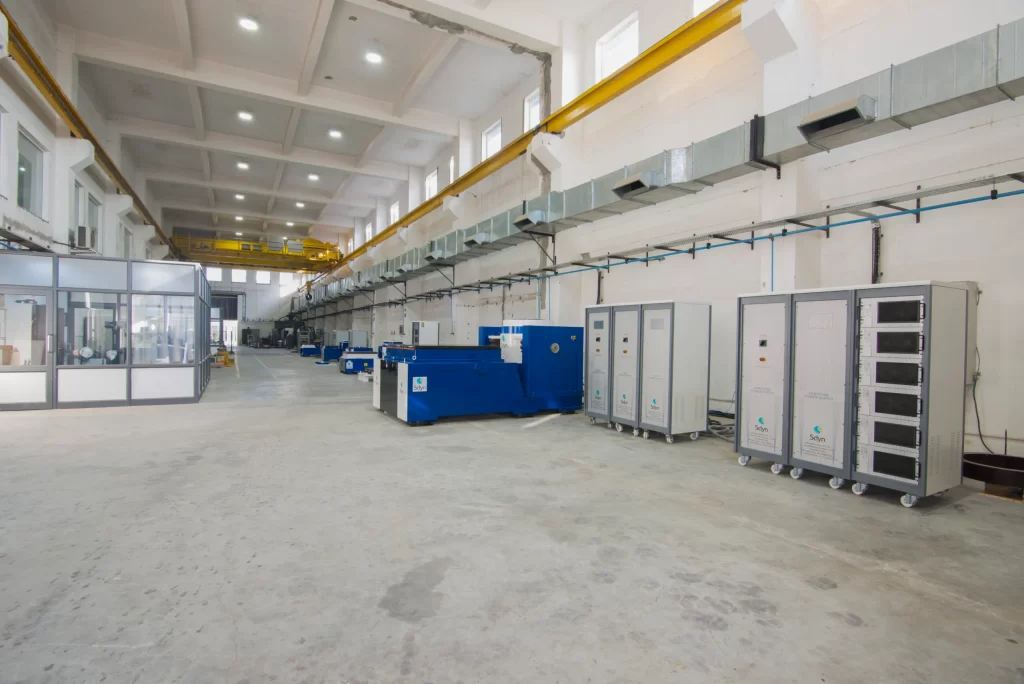
Advanced Vibration Test Systems for Reliable Product Testing
A Vibration Test System is used to reproduce controlled mechanical vibration conditions in a laboratory and evaluate how products, components and assemblies perform under vibration. These systems help manufacturers and testing laboratories assess product durability, structural integrity, reliability and performance before products are used in real-world conditions.
At SDYN, we design and manufacture vibration testing solutions for applications across aerospace, automotive, defense, electronics, EV and battery, railway, industrial and research sectors. Our systems can be configured according to the test profile, payload, frequency range, acceleration, displacement and application requirements.
What Is a Vibration Test System?
A Vibration Test System is a complete testing setup used to generate, control and measure mechanical vibration. Depending on the application, a system may combine a vibration shaker with a controller, power amplifier, sensors and supporting equipment.
A typical Vibration Testing System can include:
- Vibration shaker
- Power amplifier
- Vibration controller
- Accelerometers and sensors
- Horizontal slip table
- Head expander
- Vibration isolation system
- Test fixtures
These components work together to create controlled and repeatable vibration conditions for laboratory testing.
How Does a Vibration Test System Work?
A Vibration Test System starts with a predefined vibration test profile. The vibration controller generates the required test signal and sends it to the power amplifier.
The amplifier supplies the required electrical power to the shaker, which produces mechanical vibration. Sensors measure the response of the test specimen, and the controller uses this feedback to maintain the required test conditions.
Test Profile → Controller → Power Amplifier → Shaker → Test Specimen → Sensors → Feedback
This closed-loop operation allows engineers to monitor and control vibration throughout the test.
SDYN Vibration Test Systems
SDYN provides Industrial Vibration Test System solutions designed for different product testing requirements. System configuration can be selected according to the product, test standard and required vibration profile.
Important selection parameters include:
- Force rating
- Frequency range
- Acceleration
- Displacement
- Velocity
- Payload
- Armature size
- Test specimen dimensions
- Test direction
- Test duration
- Required vibration profile
This approach helps ensure that the Vibration Testing Machine is suitable for the intended application and testing conditions.
Types of Vibration Test Systems
Different products require different vibration testing methods. SDYN systems can be configured for a range of laboratory testing requirements.
Sine Vibration Testing System
A sine vibration system produces controlled sinusoidal vibration at defined frequencies and levels. It can be used for resonance investigation, product characterization and qualification testing.
Random Vibration Testing System
Random vibration testing reproduces broadband vibration environments that products may experience during transportation or operation. It is commonly used for durability and reliability evaluation.
Shock and Vibration Testing System
Some applications require both vibration and mechanical shock testing. An integrated setup can be configured according to the required test conditions.
Multi-Axis Vibration Testing System
Multi-axis testing allows products to be evaluated under vibration conditions involving more than one direction, depending on the system configuration and application.
Product Vibration Testing System
A Product Vibration Testing System is used to evaluate how a product or component responds to controlled mechanical vibration.
Testing can help engineers identify:
- Structural weaknesses
- Resonance conditions
- Loose components
- Mechanical fatigue
- Mounting issues
- Design limitations
- Performance changes under vibration
Testing products in a controlled laboratory environment can support design validation, qualification and reliability evaluation.
Key Components of a Vibration Testing System
Vibration Shaker
The shaker generates the mechanical vibration required for the test. Electrodynamic shakers are commonly used where precise and programmable vibration excitation is required.
Power Amplifier
The power amplifier provides the electrical power required to drive the shaker according to the test profile.
Vibration Controller
The controller manages the vibration test and processes feedback from sensors. It helps maintain the required test profile during operation.
Accelerometers and Sensors
Sensors measure vibration response and provide feedback to the control system. Proper sensor placement is important for obtaining reliable test results.
Horizontal Slip Table
A horizontal slip table allows testing in the horizontal direction and can be used when the specimen requires a different test orientation.
Head Expander
A head expander increases the mounting area of the shaker, allowing larger components or assemblies to be tested.
Applications of Vibration Test Systems
Vibration testing is used across industries where products or components may be exposed to mechanical vibration during operation, transportation or service.
Aerospace and Defense
Used to evaluate aerospace components, electronic assemblies and defense equipment against defined vibration environments.
Automotive
Supports testing of vehicle components, sensors, electronic systems and assemblies for durability and vibration response.
Electronics and PCB
Helps evaluate PCB assemblies, electronic equipment and sensitive components for mechanical reliability.
EV and Battery
Used for vibration testing of battery modules, battery packs and other electric vehicle components according to applicable test requirements.
Railway
Supports testing of railway equipment and components exposed to vibration during operation and transportation.
Industrial Equipment
Used to assess the durability and performance of industrial machines, assemblies and components under controlled vibration conditions.
Research and Development
Helps R&D teams investigate product behavior, resonance, structural response and design performance during product development.
Benefits of Vibration Testing
A properly configured Vibration Test System can help organizations:
- Evaluate product durability
- Identify potential mechanical weaknesses
- Investigate resonance and vibration response
- Support reliability testing
- Combined environmental testing
- Support reliability testing
- Perform repeatable laboratory tests
- Compare product performance under defined conditions
The test method and system configuration should always be selected according to the product, test objective and applicable requirements.
Vibration Test System Manufacturer
SDYN is an Indian Vibration Test System Manufacturer providing vibration testing equipment and integrated testing solutions for industrial and research applications.
Our solutions can include vibration shakers, power amplifiers, vibration controllers, slip tables, head expanders and other supporting equipment required for a complete testing setup.
As a Vibration Testing System Manufacturer, SDYN focuses on configuring systems according to application requirements rather than offering a one-size-fits-all setup. System selection can be based on force, frequency, payload, displacement, acceleration and the required vibration test profile.
Vibration Test Solutions for Different Requirements
Every product has different vibration testing requirements. Factors such as product size, weight, operating environment, mounting arrangement and test profile can influence the selection of equipment.
SDYN provides Vibration Test Solutions that can be configured for:
- Product qualification
- Design validation
- Durability testing
- Reliability testing
- Environmental testing
- Transportation-related vibration testing
- Research and development
The complete system can be selected and integrated according to the specific testing application.
Choose the Right Vibration Test System
Selecting the right Vibration Test System requires understanding the product, test objective, payload and required vibration conditions.
SDYN provides engineered Vibration Test Solutions for different industrial and laboratory applications, with system configurations designed around specific testing requirements.
Contact SDYN to discuss your application and identify a suitable vibration testing setup for your product or component.
Our India Supply Network
Chennai, Jamshedpur, Nashik, Lucknow, Ahmedabad, Aurangabad, Banda, Gandhinagar, Goa, Indore, Jabalpur, Kolhapur, Nagpur, Vadodara, Kolkata, Aligarh, Roorkee, Gurugram, Noida, Baddi, Bahadurgarh, Ballabgarh, Bawal, Bhanur, Bhiwadi, Barrackpore, Bhubaneshwar, Chandigarh, Coimbatore, Dehradun, Faridabad, Ghaziabad, Guwahati, Haridwar, Hoshiarpur, Hosur, Jaipur, Kanpur, Kharagpur, Koraput, Korwa, Madurai, Manesar, Manipal, Mohali, Mysore, Palwal, Pilani, Pondicherry, Rajkot, Rewari, Sonipat, Thiruvananthapuram, Ropar, Rourkela.
Our International Supply Network
Bulgaria, Canada, Russia, China, France, Indonesia, Iran, Israel, Malaysia, Poland, Portugal, Singapore, Spain, Thailand, USA, United States, Germany, France, United Kingdom, Japan, South Korea, Morocco, South Korea, North Korea.
