
High-Force Electrodynamic Shaker
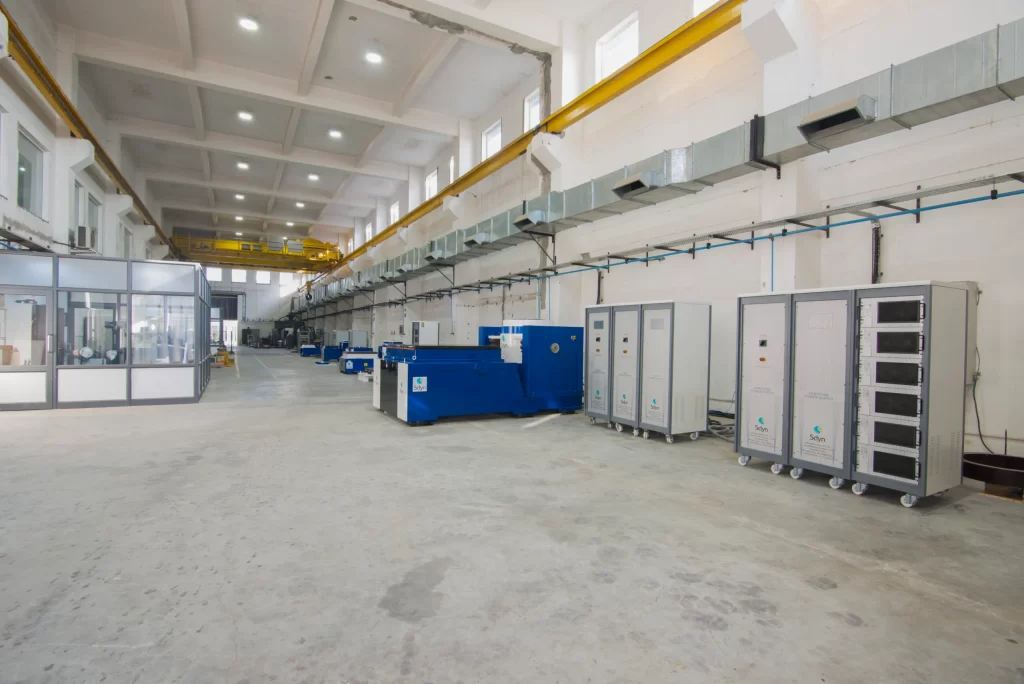
High-Force Electrodynamic Shaker for Demanding Vibration Testing
A High-Force Electrodynamic Shaker is designed to generate powerful, controlled vibration for testing large, heavy or structurally demanding products and assemblies. These systems are used when standard vibration equipment does not provide the required force, payload capability or test envelope.
SDYN provides configurable high-force vibration testing solutions for aerospace, automotive, defense, EV and battery, electronics, railway, industrial and research applications. System selection can be based on force, frequency, acceleration, displacement, velocity, payload and test profile.
What Is a High-Force Electrodynamic Shaker?
A High-Force Electrodynamic Shaker uses electromagnetic force to generate controlled mechanical motion. The shaker transfers this excitation to a test specimen so engineers can evaluate its response under defined vibration conditions.
- Large or heavy test specimens
- High vibration force requirements
- Structural or durability testing
- Long-duration test profiles
- High-energy vibration environments
- Large assemblies and components
- Demanding qualification and validation programs
The complete system can be configured around the characteristics of the product and the required test conditions.
How Does a High-Force Vibration Shaker Work?
The operating principle is based on electromagnetic force. A vibration controller generates the required test signal, while the power amplifier supplies the electrical power needed to drive the shaker.
The shaker converts this electrical input into controlled mechanical vibration. Feedback sensors continuously measure the response of the test specimen, allowing the controller to regulate the vibration according to the programmed test profile.
Vibration Controller → Power Amplifier → High-Force Shaker → Test Specimen → Sensors → Feedback
This closed-loop arrangement helps maintain controlled and repeatable vibration conditions during testing.
Why Use a High-Force Shaker System?
The required shaker force depends on factors such as test specimen mass, acceleration requirements and the desired vibration profile. Larger or heavier products may require substantially greater dynamic force to achieve the intended test conditions.
A High-Force Shaker System can be suitable when testing requires:
- High dynamic force output
- Large payload support
- Greater excitation capability
- Structural durability evaluation
- Large component or assembly testing
- Extended testing under controlled conditions
- Intensive vibration profiles
The correct system should be selected from the complete test requirement rather than force rating alone.
Key Components of a High-Force Electrodynamic Shaker System
High-Force Electrodynamic Shaker
The shaker is the primary excitation unit. It generates the controlled mechanical vibration required to test the product, component or assembly.
High-Power Amplifier
The power amplifier provides the electrical power required to operate the shaker and reproduce the programmed vibration profile.
Digital Vibration Controller
The controller generates test signals and processes feedback from accelerometers and other sensors to maintain the required vibration conditions.
Head Expander
A head expander provides a larger mounting surface when the test specimen is wider than the standard shaker armature.
Horizontal Slip Table
A horizontal slip table enables horizontal-axis testing and can be used when the product needs to be tested in a different orientation.
Vibration Isolation System
The isolation arrangement helps manage the dynamic forces generated during operation and supports stable shaker performance.
Test Fixtures
Application-specific fixtures provide secure mounting and help transfer the required vibration input to the test specimen.
High-Force Vibration Testing Equipment
High-Force Vibration Testing Equipment is generally used where product size, payload or test severity demands greater dynamic excitation.
Depending on the application, a complete setup may include:
- Electrodynamic shaker
- Power amplifier
- Vibration controller
- Accelerometers and sensors
- Head expander
- Horizontal slip table
- Isolation system
- Test fixtures
- Cooling arrangement
The equipment configuration should be matched to the required force, payload, frequency range, displacement, acceleration and test profile.
Applications of High-Force Electrodynamic Vibration Systems
A High-Force Electrodynamic Vibration System can be used for testing products and structures across demanding industrial sectors.
Automotive Testing
High-force vibration testing can be used for vehicle components, large assemblies, structural parts, electronics, powertrain components and other automotive systems.
EV and Battery Testing
Large battery assemblies, battery packs, electric vehicle components and related structures can require controlled vibration testing to evaluate mechanical response and durability.
Aerospace and Defense
Aerospace structures, defense equipment, electronic assemblies and other mission-critical components may require vibration qualification and durability testing under defined test profiles.
Railway Testing
Railway components and assemblies can be evaluated under controlled vibration conditions to study structural response, durability and reliability.
Industrial Equipment
Large industrial components, machinery and assemblies can be tested to identify vibration-related weaknesses before deployment.
Electronics and Large Assemblies
High-force systems can support testing of larger electronic assemblies and equipment where higher excitation levels or increased payload capacity are required.
Research and Development
R&D laboratories can use high-force vibration systems for prototype evaluation, structural studies, resonance investigations, design validation and product development.
Benefits of a High-Force Vibration Shaker
A properly configured High-Force Shaker can provide:
- High dynamic force capability
- Support for large and heavy test specimens
- Controlled and repeatable vibration testing
- Flexible vertical and horizontal test configurations
- Integration with head expanders and slip tables
- Support for different vibration test profiles
- Application-specific system configuration
- Suitable solutions for qualification, durability and R&D testing
Performance should always be evaluated against the complete test requirement, including payload, frequency, displacement, acceleration and test duration.
High-Force Electrodynamic Shaker Manufacturer
SDYN designs and manufactures High-Force Electrodynamic Shaker Systems for demanding vibration testing applications.
Our vibration testing solutions can be configured with high-force shakers, power amplifiers, digital controllers, head expanders, horizontal slip tables, isolation systems and other supporting equipment.
SDYN’s existing vibration systems include configurations designed for high dynamic force output, large assembly testing and demanding durability evaluations.
The appropriate configuration can be developed according to the test specimen, payload, vibration profile, force requirement, frequency range and operating conditions.
High-Force Shaker for Large and Heavy Test Specimens
Testing large or heavy products requires more than simply increasing shaker force. The complete test setup must be considered, including payload, fixture design, mounting surface, center of gravity, required acceleration and vibration direction.
For this reason, a High-Force Shaker System may be integrated with a suitable head expander, slip table, fixture and control system to create a complete testing configuration.
This approach helps ensure that the vibration input is appropriate for the product being evaluated and the intended test objective.
How to Select a High-Force Electrodynamic Shaker
Before selecting a High-Force Electrodynamic Shaker, consider:
- Required force level
- Test specimen weight
- Payload distribution
- Frequency range
- Maximum acceleration
- Displacement and velocity
- Vertical or horizontal testing
- Test profile
- Test duration
- Fixture and mounting requirements
- Cooling requirements
- Required control and measurement system
A properly matched system provides a more suitable testing envelope and avoids selecting equipment based on a single specification.
Choose the Right High-Force Electrodynamic Shaker
Choosing the right High-Force Electrodynamic Shaker requires a complete understanding of the test specimen, payload, force requirement, frequency range, acceleration, displacement and test profile.
SDYN provides configurable high-force vibration testing solutions for industrial, research and laboratory applications. Share your testing requirements with SDYN to determine a suitable shaker system and supporting configuration.
Our India Supply Network
Chennai, Jamshedpur, Nashik, Lucknow, Ahmedabad, Aurangabad, Banda, Gandhinagar, Goa, Indore, Jabalpur, Kolhapur, Nagpur, Vadodara, Kolkata, Aligarh, Roorkee, Gurugram, Noida, Baddi, Bahadurgarh, Ballabgarh, Bawal, Bhanur, Bhiwadi, Barrackpore, Bhubaneshwar, Chandigarh, Coimbatore, Dehradun, Faridabad, Ghaziabad, Guwahati, Haridwar, Hoshiarpur, Hosur, Jaipur, Kanpur, Kharagpur, Koraput, Korwa, Madurai, Manesar, Manipal, Mohali, Mysore, Palwal, Pilani, Pondicherry, Rajkot, Rewari, Sonipat, Thiruvananthapuram, Ropar, Rourkela.
Our International Supply Network
Bulgaria, Canada, Russia, China, France, Indonesia, Iran, Israel, Malaysia, Poland, Portugal, Singapore, Spain, Thailand, USA, United States, Germany, France, United Kingdom, Japan, South Korea, Morocco, South Korea, North Korea.
